
Carmel City Directory Shelves
Carmel city directory research begins with a gap, not a continuous annual shelf. The Indiana State Library guide identifies Robinson's Carmel volumes for 1979 and 1981. Earlier names are spread across Hamilton County directories, township lists, business books, and local histories. Hamilton East Public Library, or HEPL, holds the broadest local mix in its Indiana Room. Its directory holdings reach from early county books through the twentieth century, though not for every year.
| Collection | Years | Where Held | Access |
|---|---|---|---|
| Robinson's Carmel directories | 1979 and 1981 | Indiana State Library | Print, call numbers ISLI 910 C287R 1979 and 1981 |
| Hamilton County directories | 1874, 1876, 1893-1894 | HEPL and State Library resources | Online, print, or microfilm by title |
| Business and phone books | 1896, 1902, 1907, 1916, 1920, 1926, 1929 | HEPL Indiana Room | Online resources and local holdings |
| Haines criss-cross files | 1976 to current holdings | HEPL Indiana Room | In person, search by address |
| Carmel vertical files | Topical files with dated runs | HEPL Indiana Room | Request by heading and year |
The Indiana State Library directory guide and Crossroads online collection establish what can be searched from home. A missing year should not be treated as proof that a person left Carmel. Move sideways to a county book, newspaper, census, deed, or school source.
Open the State Library's city directory guide to confirm the statewide access route and county holdings.
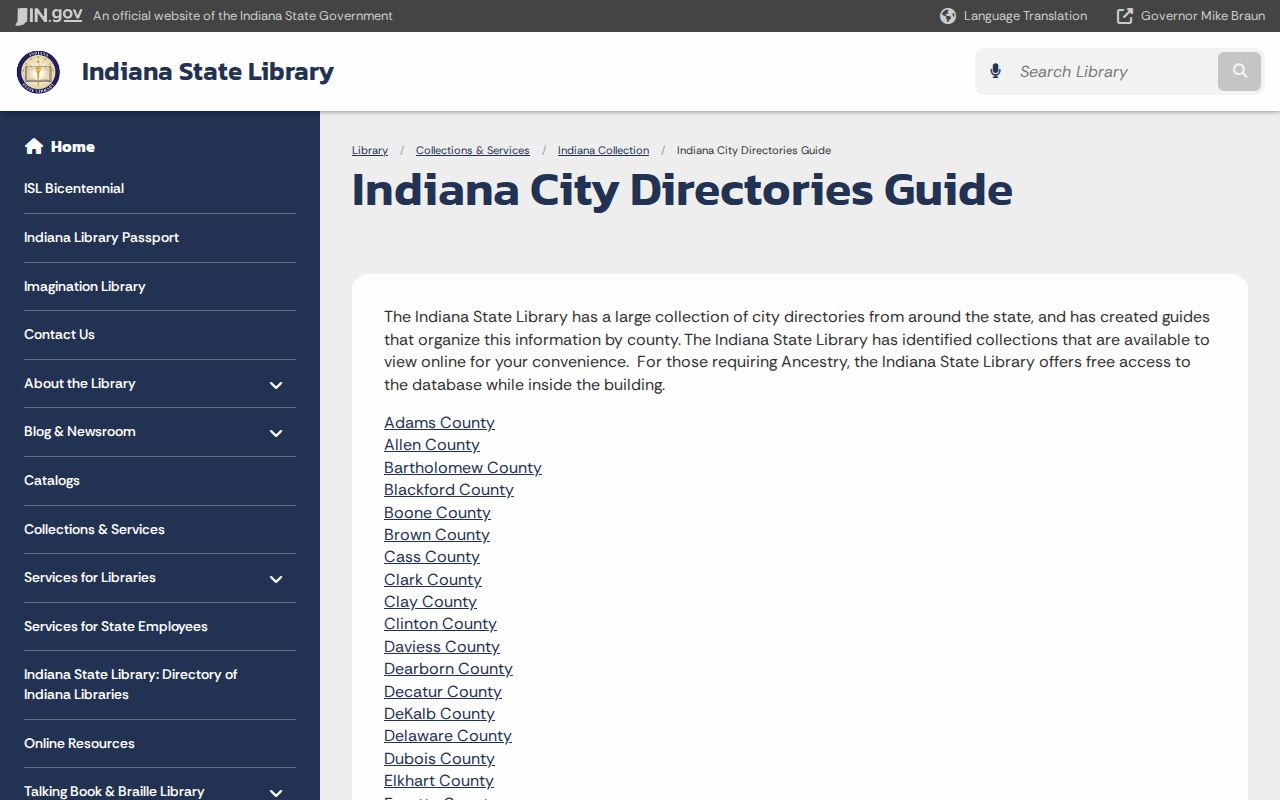
The guide directs a Carmel search toward the two stand-alone Robinson volumes and the wider Hamilton County shelf.
Carmel Names in County Books
The early printed-directory trail is filed under more than one place. The 1874 Hamilton County directory, 1876 People's Guide, and 1893-1894 county directory may place a Carmel-area person under Clay Township, a post office, a road, a farm, or a business heading. Later Noblesville phone and business books may still capture county firms or people whose work connected them to the county seat.
Use both the name and the place. Try initials, a spouse, a trade, and spelling variants. Search Carmel, Clay Township, and Bethlehem when the date reaches back before or near the community's name change. The county shelf is not a substitute for a stand-alone Carmel directory, but it is often the only printed bridge across years when no Carmel-only volume exists.
Note: A county directory entry may describe a post-office area, not the modern Carmel city boundary.
Carmel Directory Help at HEPL
The HEPL Indiana Room combines city directories with family files, surname files, maps, plats, newspapers, microfiche, yearbooks, and Hamilton County vertical files. That mix matters when a directory gives only an initial or when a street changes between volumes. Staff help is available during library hours. Researchers who need temporary access to family-history files may call 317-770-3236 for a two-hour appointment.
The room supports every main access channel for this collection: browse local material in person, use the linked digital resources, call for staff guidance, consult microfilm, or ask about a precise file heading. A public-record request is useful only for an existing public-library or city-held record. It does not create a new directory index or force staff to perform open-ended genealogy research.
See the library's local genealogy resources before a visit. The available index, history, and directory titles help turn a broad family question into a request for a named book or file.
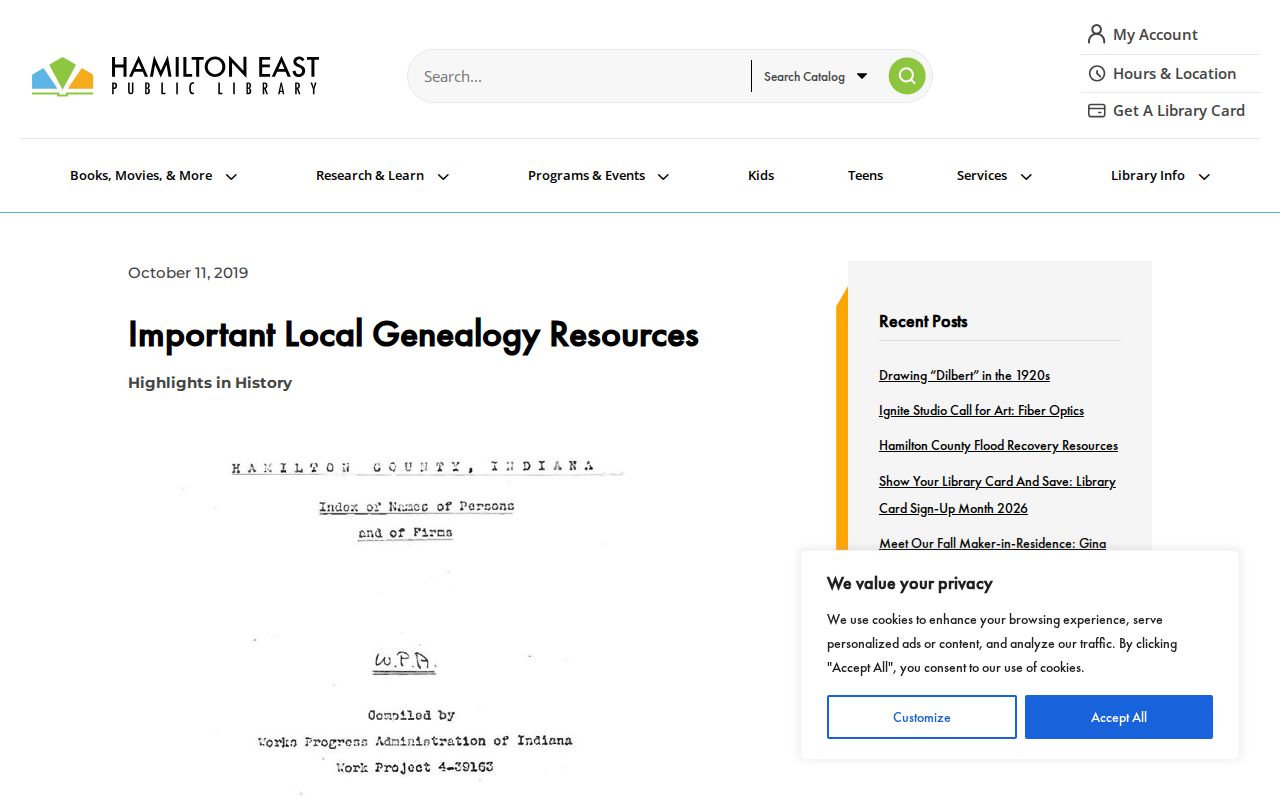
The captured library page shows the local route that supplements Carmel's incomplete printed run.
Browse the Crossroads online resources for digitized books, maps, newspapers, and directory links before planning an Indiana Room visit.
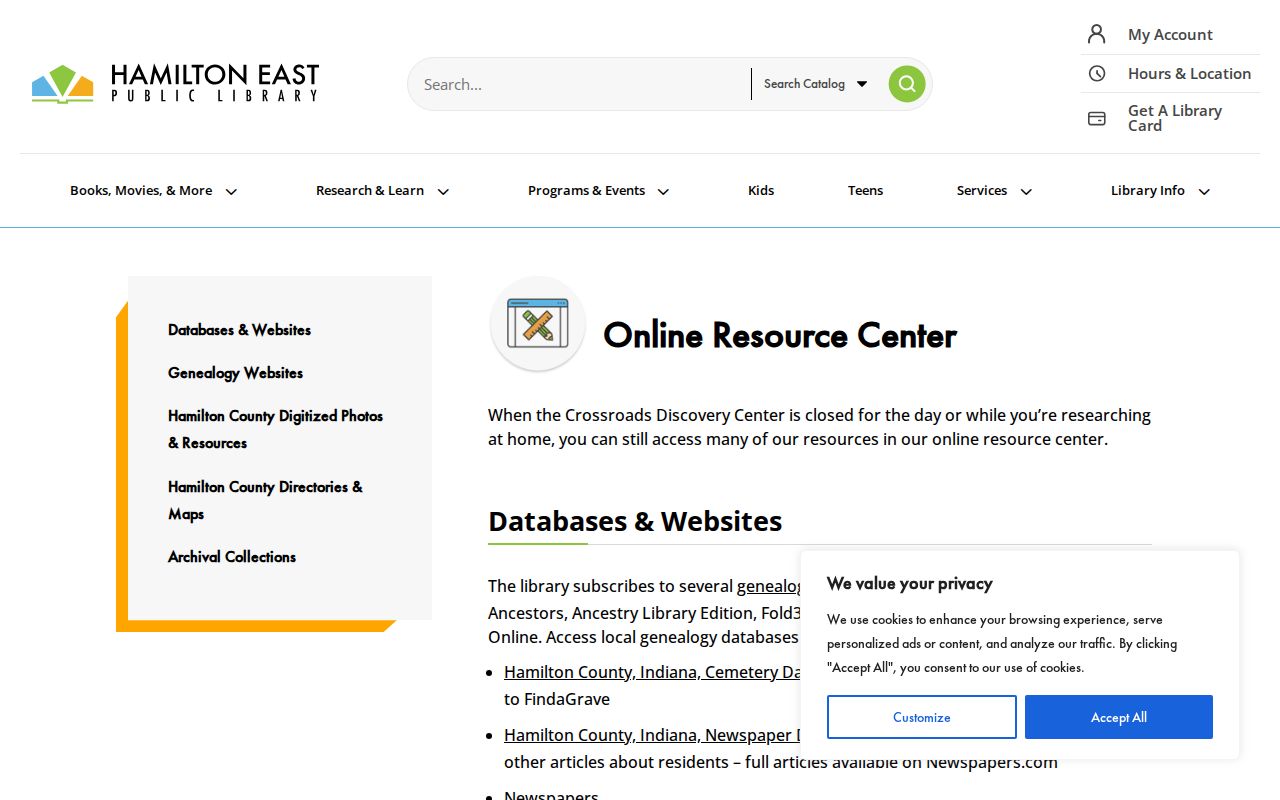
The Crossroads page separates material available online from holdings that still call for library help or an in-person search.
Read a Carmel Directory Entry
The digitized 1876 People's Guide reads more like a county sketch than a modern phone book. Its entries can give a name, town or township, post office, occupation, birthplace, settlement year, faith, political affiliation, community role, or distance from another place. Those fields are clues to migration and identity. They are not standard fields shared by every later Carmel city directory.
| Name | Printed person, household, or business name, often with initials |
|---|---|
| Place | Town, township, post office, road, or community context |
| Work and role | Trade, farm, office, firm, church, school, or civic tie |
| Origins | Birthplace or the year the person settled in Hamilton County |
| Later conventions | Spouse, employer, street, telephone, widow, or owner marks when that volume defines them |
- Criss-cross directory
- An address-first book that lists an occupant beside a street number instead of starting with a surname.
- Householder index
- A name or address list focused on the person shown as head of a household, not a full list of all occupants.
- Abbreviation key
- The volume's own list of shortened terms and symbols. Read it before interpreting a spouse, work, residence, or owner mark.
Later volumes may use spouse names in parentheses or mark a residence, employer, widow, owner, or renter. Never transfer a symbol from one publisher to another. Check the front matter, then save the page number and the key with the entry.
Inspect the digitized 1876 People's Guide to see how its narrative fields differ from a later address book.
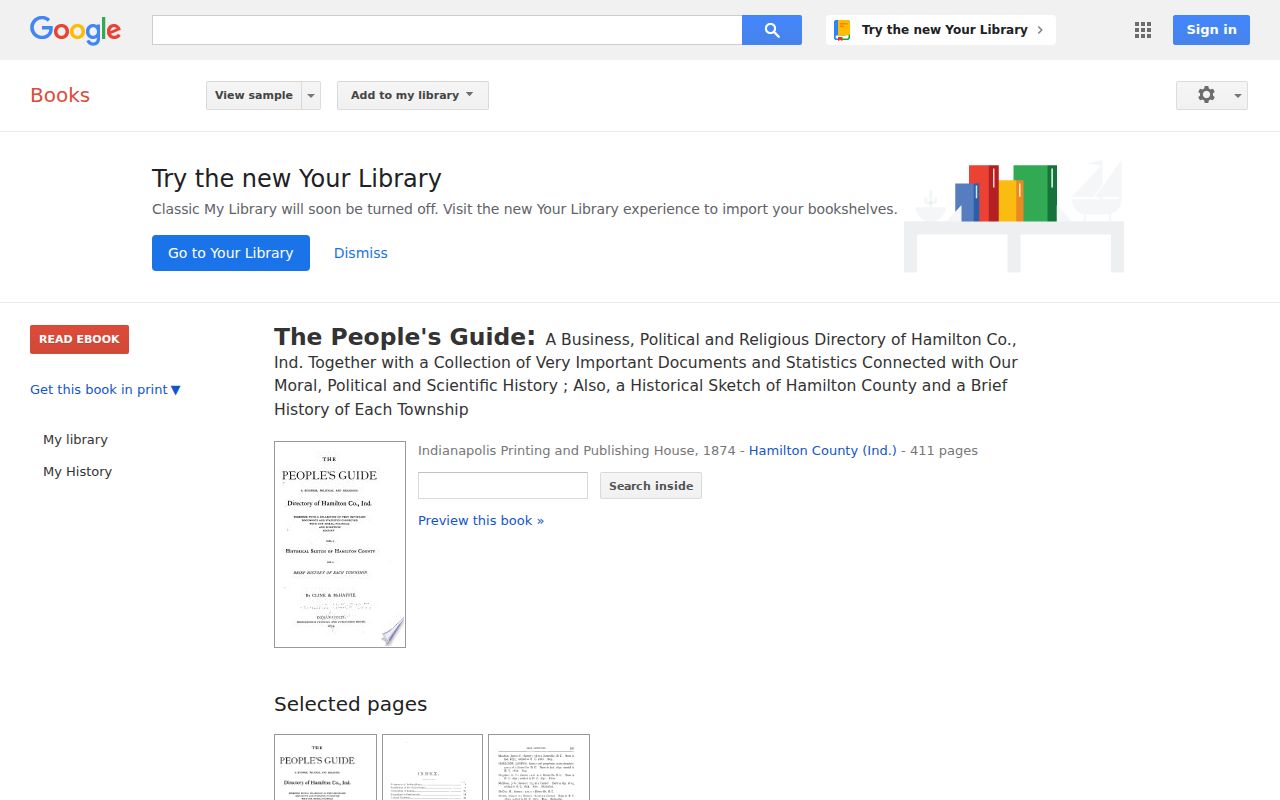
The digitized volume makes early names searchable while preserving the township, post-office, and community context needed to identify them.
Carmel Criss-Cross Directory Years
HEPL's Haines criss-cross holdings begin in 1976 and continue through its most current files. This reverse format changes the usual task: start with a street and house number, then read the occupant printed beside it. Compare the same address in nearby years to spot a move or a change in the listed household.
A criss-cross result is a dated publication entry, not proof of who lives there now. Pair it with a deed, obituary, census, or newspaper when tracing an older household. For a modern parcel and ownership path, use the Carmel street directory workflow instead of treating an old address book as current.
Address-first surprise. Haines books are not ordinary alphabetical directories, so use the street number before trying a surname.
Bethlehem Names in Carmel Records
Carmel was platted as Bethlehem in 1837. A duplicate Indiana post-office name led residents to choose Carmel in an 1874 vote, 33 to 12. That place-name change is practical search data. An early city directory or county history may file a person under Bethlehem, Carmel, Clay Township, or a nearby post-office label.
The old name also helps with newspapers, church material, census geography, and land descriptions. Record the heading exactly as printed. Then connect it to later Carmel evidence through a name, relative, occupation, road, or parcel. The date and place join are stronger than a surname match by itself.
Note: Search both Bethlehem and Carmel when a family appears in Hamilton County records around the 1874 name change.
Carmel Directory Companion Sources
A directory gap can often be crossed with a source that records people for a different reason. HEPL's newspaper database indexes local obituaries and articles. Its newspaper collection covers Hamilton County publications from 1837 through 2008, while the Indiana Room also holds microfilm. School directories and yearbooks can distinguish classmates or staff. WPA indexes point toward older birth, death, marriage, naturalization, and probate records.
- Search an obituary index by surname and estimated death date, then read the article.
- Check yearbooks and school directories for a name, grade, role, or photograph.
- Use cemetery data as a lead, then verify it with a custodian, obituary, or death record.
- Ask for Carmel vertical files by exact topic and year band.
- Route church questions by denomination and congregation because no complete Carmel register list was found.
The Crossroads resources page gathers many of these routes. Index entries point toward evidence, but the cited newspaper, certificate, book, or case remains the source to verify.
Carmel's Monon Archive Story
The Carmel Clay Historical Society preserves a strong person-and-place bridge. The Monon line reached Carmel in 1882, its depot opened in 1883, and the depot remained open until 1974. Railroad photographs, business material, oral histories, and local files can add context to a directory name.
The Carmel Clay History Museum opened in November 2024 with galleries, meeting space, and archives. It is an in-person archive route, not a complete online resident index. Ask staff about a named person, business, street, or date range.
The museum page identifies a newer public-history home for Carmel and Clay Township records that may not appear in a city directory.
Trace Family Through Carmel Directories
A Carmel city directory works best as one dated point in a longer trail. Keep the original spelling and initial while also testing variants. Use a spouse, occupation, school, firm, or post office to separate people who share a name. Federal census schedules currently open through 1950 can show a historical household, while a deed shows ownership and an obituary may explain a move or death.
- Start with a known name, address, spouse, trade, or post office in the county and Carmel volumes.
- Move through available years, noting each spelling, address, occupation, and household change.
- For 1976 onward, check the same address in the Haines criss-cross files.
- Pair directory dates with open federal census years, remembering that a census is only a dated household snapshot.
- Test the result in deeds, marriage and death indexes, obituaries, probate, cemetery records, and newspapers.
A person who disappears may have moved, died, changed a surname, been omitted, or fallen into a missing publication year. Do not choose one explanation from absence alone. Continue with the next available volume and search the newspaper, probate, vital index, and deed trail around the last known date.