
Carmel Previous Resident Sources
A backward address search uses records that answer different questions. The Hamilton County property report gives the present parcel and transfer clues. Recorder indexes establish parties to deeds, while Hamilton East Public Library materials can place people at an address even when they rented. Federal census schedules supply household snapshots after the public-release delay. Probate, newspapers, and cemetery indexes help explain why a name disappears from a later record.
| Source | Years It Covers | Where Held | What It Shows |
|---|---|---|---|
| Hamilton deed index | Modern deeds from February 1947; historical indexes from 1870 | Recorder portal and office | Grantors, grantees, document dates, and legal keys |
| Haines criss-cross files | From 1976 | Hamilton East Indiana Room | Address-to-occupant entries |
| Carmel and county directories | County volumes from the 1800s; Carmel titles for 1979 and 1981 | State Library and Hamilton East | Named households, addresses, and occupations |
| Federal census | Released schedules through 1950 under the 72-year rule | Library genealogy databases | Household members and relationships at a point in time |
| Probate and newspapers | Varies by collection | County Clerk and Hamilton East | Deaths, heirs, moves, and estate transfers |
For a late twentieth-century question, start with the parcel and criss-cross files. An older Carmel address often requires deeds, directories, census schedules, and historical maps in tandem. Search both Carmel and Bethlehem for material before the city’s name changed, and keep Clay Township in mind because county records may be organized by township rather than city.
Anchor a Carmel Address
The Hamilton County Property Reports and Payments search accepts a property address, mailing address, county duplicate number, or state parcel number. Once the correct parcel is open, save its location address, both parcel identifiers, legal description, current ownership, and transfer history. A parcel is a mapped unit of land. It is more stable than a mailing label and helps distinguish two similar addresses.
Mailing and location addresses can differ. The mailing address is where tax correspondence goes; the location, also called the situs address, is where the land sits. Neither field alone proves who occupies the property. The report is an ownership and tax record, not a household roll. Use the legal description when an old deed omits the modern street number.
Carmel Deeds Span Two Eras
Hamilton County’s recorded-document search has a modern deed index beginning in February 1947. Separate historical deed indexes reach back to 1870, and selected deed-book images cover May 1899 through January 1949. Miscellaneous records begin online in 1973, while historical miscellaneous indexes cover 1914 through 1960 with selected book images.
Index coverage does not promise that every image is online. Tapestry is the occasional paid route, Laredo Anywhere is subscription access, and the Recorder’s office has a free public terminal. Staff preserve and copy instruments but do not perform the chain search for a visitor. That difference matters when tracing previous residents: arrive with party names, document numbers, date ranges, and the legal description already organized.
The county’s Recorder office page is the best place to confirm counter access before making the trip.
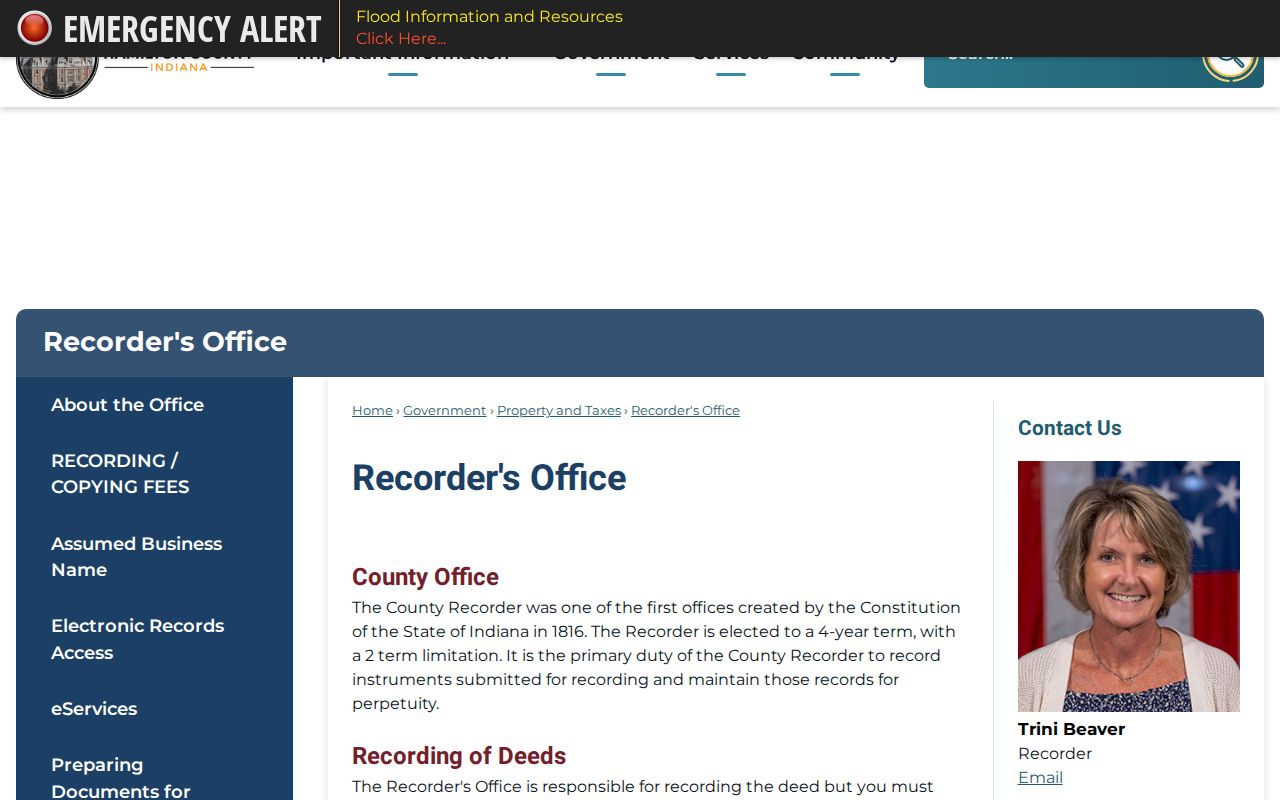
The office route matters most when an index row exists but its deed image does not appear online.
Note: New recorded documents usually appear within a day, but historical book and image limits should be confirmed with the Recorder.
Trace Hamilton County Past Owners
A chain of title is the linked sequence of transfers for one parcel. Begin with the newest reliable owner, then move backward one deed at a time. The seller named on one purchase usually becomes the buyer to seek in the earlier purchase. Verify each link with the property description, not with the surname alone.
- Open the current property report and copy the owner, parcel numbers, transfer date, and full legal description.
- Find that owner’s purchase deed in the Recorder index. Record the grantor, document number, date, book/page, and property description.
- Search the grantor as an earlier grantee. Test surname variants and entity names, then match the land description.
- Repeat until the trail crosses the modern online cutoff. Move to the historical index and digitized book range where available.
- Use the free office terminal or request a known instrument copy when an online image is missing.
- Grantor / grantee
- The grantor transfers an interest; the grantee receives it.
- Chain of title
- The sequence of recorded transfers connecting current title to earlier title.
- Legal description
- The lot, subdivision, block, or metes-and-bounds wording that identifies land even when its street label changes.
The county’s recorded document types distinguish deeds from easements, plats, releases, mortgages, and related instruments.
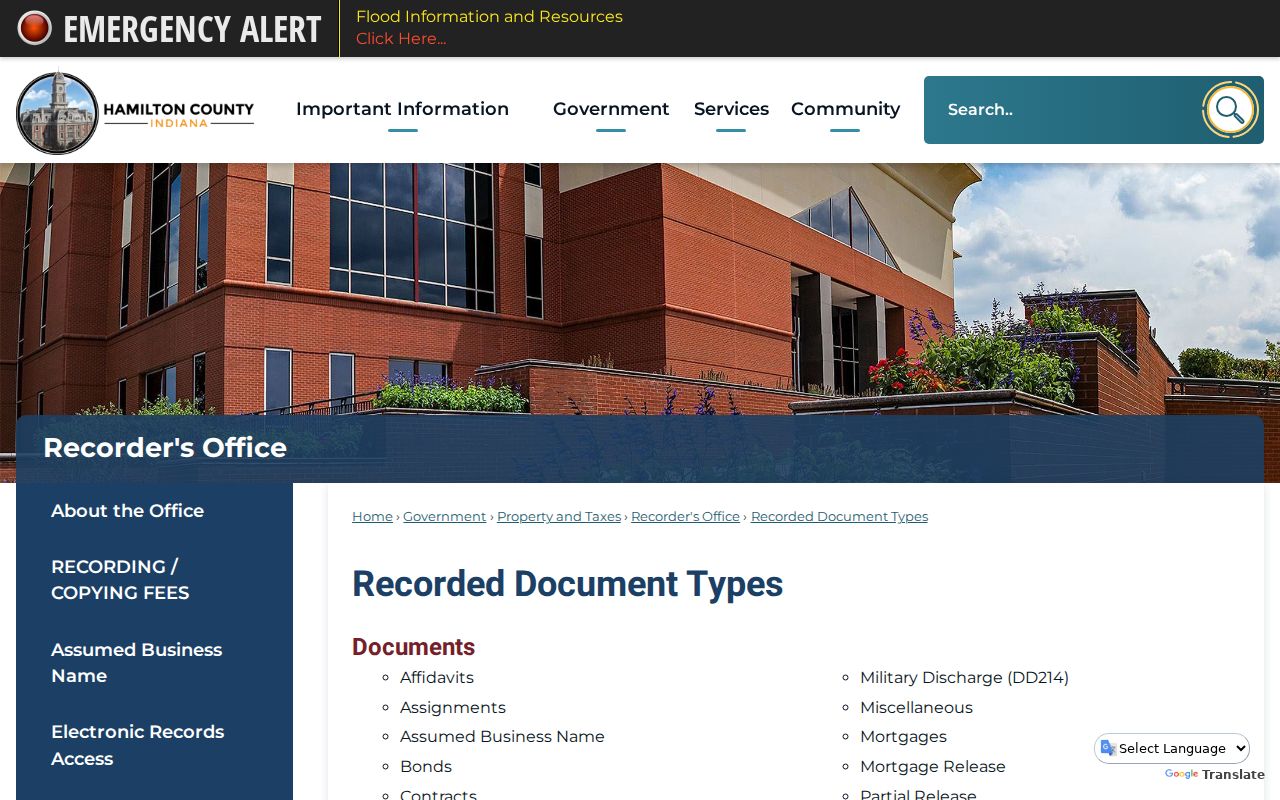
That list helps narrow a search when one name appears in many unrelated filings.
Carmel Addresses in Criss-Cross Files
Ownership does not equal occupancy. Hamilton East Public Library’s Indiana Room holds Haines criss-cross directories beginning in 1976. Unlike a normal alphabetical directory, a criss-cross volume begins with the address and then names the listed occupant. Compare the same address in adjacent years to narrow a move-in or move-out interval.
The standalone Carmel Robinson directories for 1979 and 1981 and the broader county directory shelf can fill some gaps. They do not form a complete annual run. Use the Carmel city directory collections for the precise holdings, then bring a short list of years and address forms to the library. The Indiana Room also offers family files, maps, vertical files, newspapers, and staff help by appointment or phone.
No Carmel Sanborn Series
No official Carmel Sanborn fire-insurance map series was located in the researched collections. Hamilton East points to Sanborn material for Noblesville and Sheridan, so assigning those sheets to a Carmel property would create a false trail. Use plats, county maps, aerial photographs, deed descriptions, and Carmel or Hamilton County GIS instead.
The State Library’s Hamilton County genealogy guide sets out the wider research path.
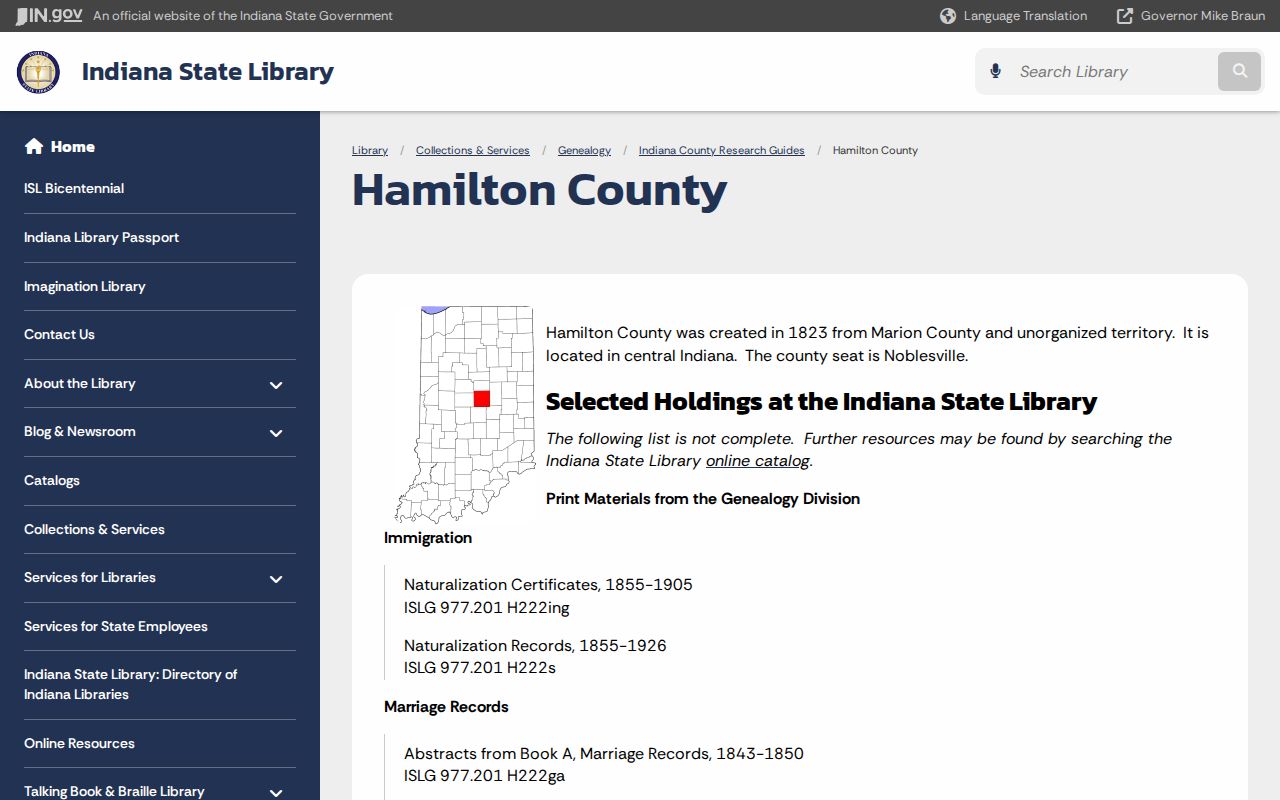
Its county-level indexes can bridge years missing from a Carmel directory run.
The Indiana State Library Hamilton County guide leads to WPA indexes, county histories, probate abstracts, and repository notes. The Indiana State Archives catalog adds finding aids and a reading-room request route for transferred records. Search the catalog first, then ask for a specific series or box.
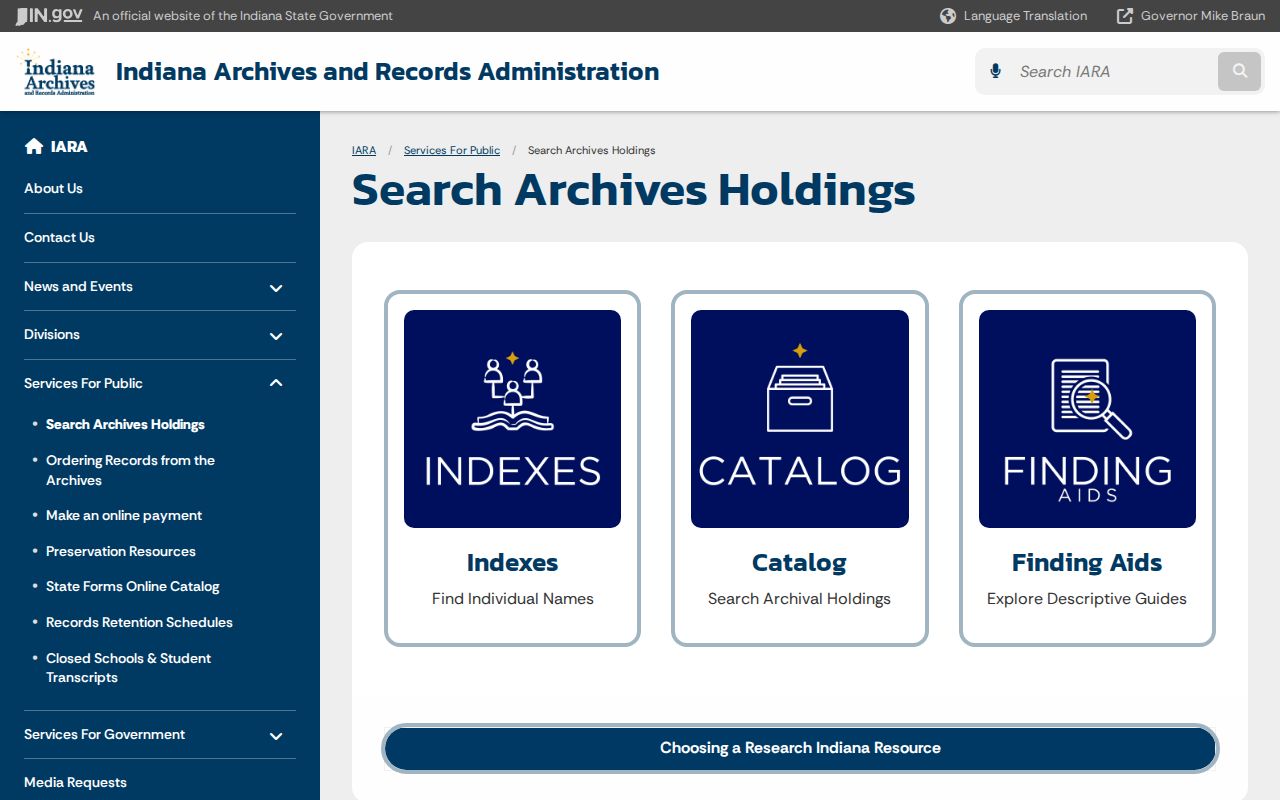
Catalog results are finding aids, so a reading-room request may still be needed to see the record itself.
Bethlehem Before Carmel Residents
Carmel was platted as Bethlehem in 1837. A duplicate Indiana post-office name led residents to vote 33 to 12 for Carmel in 1874. That local change affects name searches: a person, business, church, or land entry may sit under Bethlehem, Carmel, or Clay Township depending on the year and keeper.
The Monon railroad is another useful bridge. Carmel’s depot opened in 1883 and closed in 1974. The Carmel-Clay Historical Society and Monon Depot collect local photographs, objects, and stories, while the Carmel Clay History Museum opened a new archives and public-history space in November 2024. Ask for catalog help rather than expecting a searchable resident index.
The local archive adds context to a deed or directory name but does not replace record-level proof.
Confirm Carmel Past Households
Directories and deeds should be paired with released census schedules. A census is a dated household snapshot, not a current roll. Start with a directory entry near a census year, find the family in that census, and compare names, ages, relationships, occupations, and nearby households. Then test the next available directory year. Because federal schedules open after 72 years, the latest public census is 1950.
- Fix the parcel and its older address forms with deeds, plats, and maps.
- Check a directory or criss-cross entry just before and after a released census year.
- Match the household by names, ages, work, neighbors, and township geography.
- Use newspapers, cemetery data, and probate when a person dies or vanishes from the run.
The Hamilton County Clerk keeps estates and guardianship files, while MyCase offers non-confidential case discovery. Hamilton East’s obituary and newspaper indexes can supply death notices, relatives, former addresses, and burial clues. These sources may close the story of who lived here before, but every name still needs corroboration because same-name errors are common.
Lawful use. Research previous residents for house history, genealogy, estates, or personal curiosity. Never use an address trail to watch, harass, or harm a living person.